CBSE Class 8 Science Notes Chapter 10 PDF Download
 Ananya Gupta18 Jun, 2026
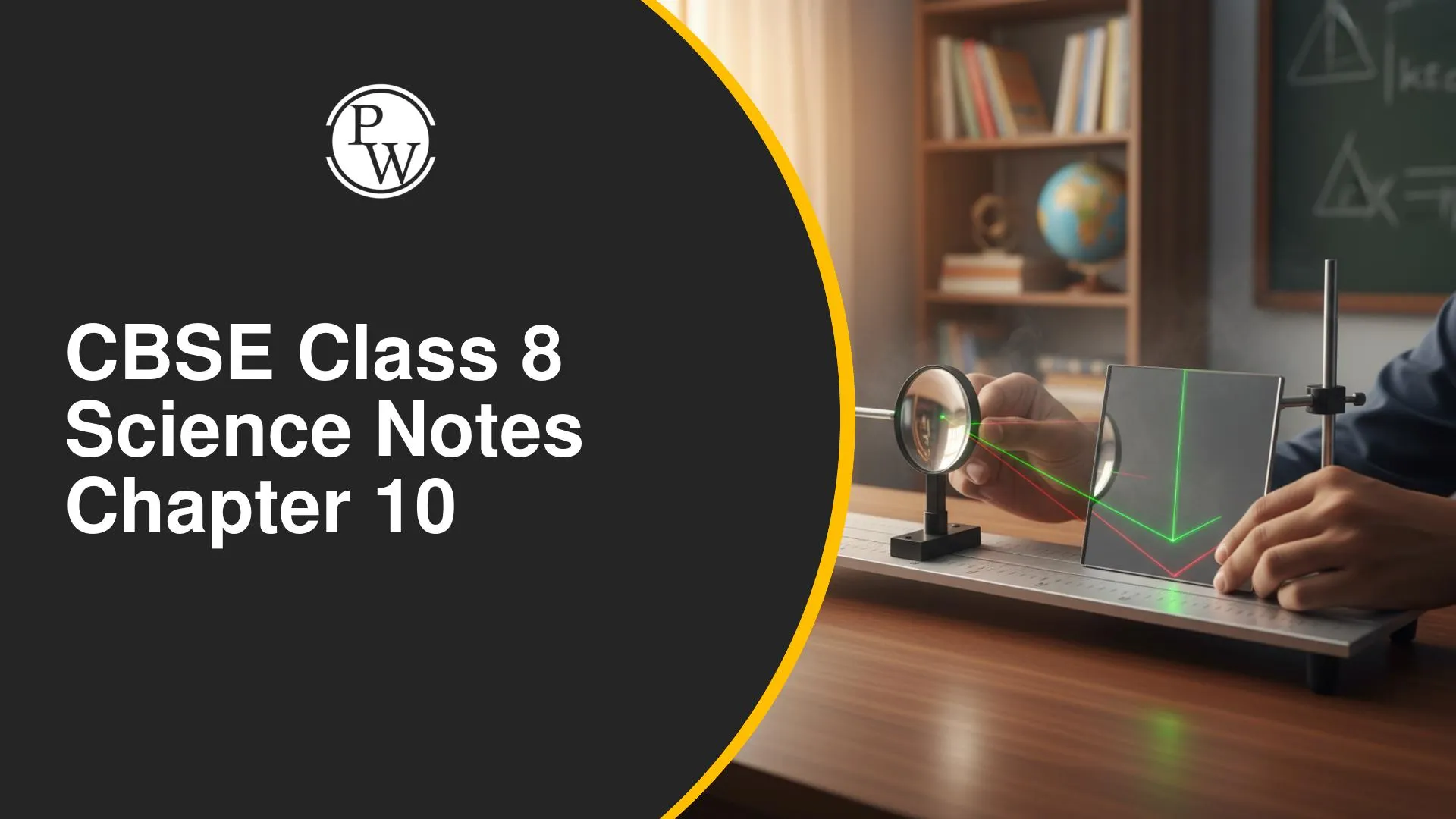
Light is an essential form of energy that enables us to see objects around us. In CBSE Class 8 Science Chapter 10, students learn how light reflects from mirrors, passes through lenses, and forms images.
Understanding these concepts helps build a strong foundation in optics and explains the working of everyday optical devices such as mirrors, spectacles, cameras, and magnifying glasses.
1. Light
- Light travels in a straight line.
- It enables us to see objects by reflection.
- When light falls on a surface, it can be reflected, absorbed or transmitted.
2. Reflection of Light
- Bouncing back of light from a surface is called reflection.
Laws of Reflection:
- Angle of incidence = Angle of reflection.
- Incident ray, reflected ray and normal lie in the same plane.

3. Plane Mirror
- Forms virtual, erect and same size image.
- Image is laterally inverted (left-right reversed).
- Distance of image from mirror = Distance of object from mirror.

4. Spherical Mirrors
Two types:
- Concave Mirror (Converging mirror)
- Convex Mirror (Diverging mirror)
Important terms:
- Pole (P): Centre of the mirror
- Centre of Curvature (C): Centre of the sphere of which mirror is a part
- Radius of Curvature (R): Distance between P and C
- Principal Axis: Straight line joining P and C
- Focus (F): Point where parallel rays meet or appear to meet
- Focal Length (f): Distance between P and F


5. Concave Mirror – Image Formation
| Position of Object | Position of Image | Nature of Image |
|---|---|---|
| At infinity | At the principal focus or in the focal plane | Real, inverted, extremely diminished in size |
| Beyond the centre of curvature | Between the principal focus and centre of curvature | Real, inverted and diminished |
| At the centre of curvature | At the centre of curvature | Real, inverted and equal to object |
| Between focus and centre of curvature | Beyond centre of curvature | Real, inverted and bigger than object |
| At the principal focus | At infinity | Extremely magnified |
| Between the pole and principal focus | Behind the mirror | Virtual, erect and magnified |
Uses:
- Torch, headlights
- Shaving mirror
- Solar cooker
CBSE Class 8 Science Notes Light: Mirrors and Lenses PDF
The chapter Light: Mirrors and Lenses explains the concepts of reflection, image formation, and the functioning of mirrors and lenses. It introduces students to different types of mirrors and lenses and their practical applications. These notes provide a simple summary of all important topics for quick revision.
Students can use these notes to quickly revise key concepts before tests and examinations. For a more detailed explanation of the chapter along with comprehensive topic-wise notes, students can download the PDF provided below and study the concepts in greater detail.
CBSE Class 8 Science Notes Chapter 10 PDF
Benefits of Using Light: Mirrors and Lenses Class 8 Science Notes
CBSE Class 8 Science Notes Chapter 10 is a very helpful resource for students. These notes are written in simple language and cover all important topics from the chapter. Below are the key benefits of using these notes:
-
Easy to Understand: The notes use short and clear sentences. Students can understand difficult concepts without any trouble.
-
Covers All Topics: These notes include all important topics such as reflection, refraction, types of mirrors, types of lenses, the human eye, and dispersion of light. The notes cover all key concepts prescribed in the chapter.
-
Helpful for Exam Preparation: Students can use CBSE Class 8 Science Notes Chapter 10 to revise the chapter quickly before exams. All key points are listed in one place.
-
Includes Key Definitions and Terms: Important terms like focal length, principal axis, concave, and convex are clearly defined. This helps students answer definition-based questions with ease.
-
Supports Visual Learners: The notes include descriptions of diagrams and ray diagrams. Students can draw and label diagrams correctly using these descriptions.
-
Saves Time: Instead of reading the full textbook, students can use these notes to save time. CBSE Class 8 Science Notes Chapter 10 provides all the necessary information in a compact form.
-
Ideal for Self-Study: These notes are written in a step-by-step format. Students can study on their own without the help of a teacher.
-
Builds a Strong Foundation: Understanding light, mirrors, and lenses at the Class 8 level builds a strong base for higher classes. The concepts in this chapter are also useful in Class 10 and beyond.
-
Available in PDF Format: Students can download CBSE Class 8 Science Notes Chapter 10 in PDF format. They can study offline at any time and from anywhere.
-
Boosts Confidence: Regular revision using these notes improves conceptual clarity and boosts confidence before tests and examinations.
CBSE Class 8 Science Notes Chapter 10 FAQs
What is CBSE Class 8 Science Notes Chapter 10 about?
Why are Light: Mirrors and Lenses notes important for Class 8 students?
What topics are included in Light: Mirrors and Lenses Notes PDF?
Can CBSE Class 8 Science Notes Chapter 10 help in exam preparation?
Can I download the CBSE Class 8 Science Notes Chapter 10 PDF for offline study?