



NCERT Solutions for Class 9 Science Chapter 6: How Forces Affect Motion by PW
 Ananya Gupta16 Nov, 2026


Force plays an important role in changing the motion, speed and direction of objects. In Class 9 Science Chapter 6, you learn about friction, balanced and unbalanced forces, Newton’s laws of motion, acceleration and momentum. Applying these concepts to everyday situations and solving numerical problems can sometimes be challenging.
NCERT Solutions for Chapter 6, How Forces Affect Motion by PW, provide selected textbook questions and answers for revision. These include activity-based questions, in-text questions, exercise problems and additional questions from the chapter. You can practise them to revise important concepts and prepare for your Science examination.
Practice with CBSE Class 9 Sample Papers to understand the exam pattern, test your knowledge, and improve your preparation for school exams.
NCERT Class 9 Science Chapter 6 Solutions
The following questions cover important concepts from the activities, in-text exercises, and NCERT exercises.
Activity-Based Questions
Activity 6.1: Let us investigate
Q1. Why does the stack of coins eventually come to rest after being released?
Ans. The stack of coins comes to rest because friction acts between the bottom surface of the coins and the surface on which they move. This friction acts opposite to the motion and gradually reduces their velocity to zero.
Activity 6.3: Let us experiment
Q1. Why is it necessary to use the same cart and travel the same distance in both cases?
Ans. To ensure that the mass of the object and the displacement remain constant, allowing us to isolate and study only the relationship between force and acceleration.
Activity 6.7: Let us understand
Q1. Why does the balloon move in a direction opposite to the escaping air?
Ans. When the balloon is released, it pushes air out through its neck in one direction. According to Newton's third law, the escaping air pushes the balloon with an equal force in the opposite direction. Therefore, the balloon moves opposite to the direction of the escaping air.
Check the CBSE Class 9 Syllabus 2026–27 to get complete details of the prescribed chapters and topics and plan your studies effectively.
NCERT In-text Questions
Pause and Ponder
Q1. A weightlifter lifts a barbell. List two forces that are acting on the barbell. Are these forces balanced if the weightlifter keeps the barbell steady?
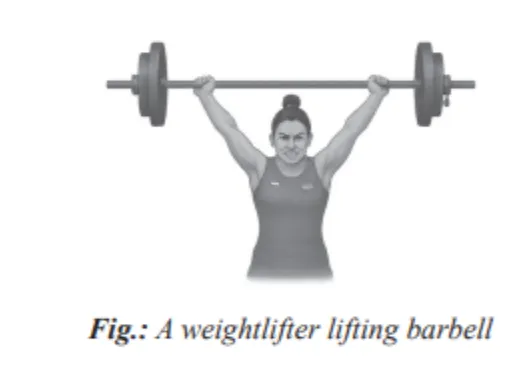
Ans. Forces acting on the barbell:
(a) Applied force by the weightlifter to lift the barbell
(b) Gravitational force (Weight)
Yes. If the weightlifter keeps the barbell steady (at rest), the net force must be zero. It shows the upward force applied by the weightlifter is equal and opposite to the downward gravitational force.
Q2. Two players R and S are participating in an arm-wrestling match. At the instant, when the arms tilt to the front direction (out of the page towards you), are the forces exerted by the players balanced? If not, which player exerted the larger force?
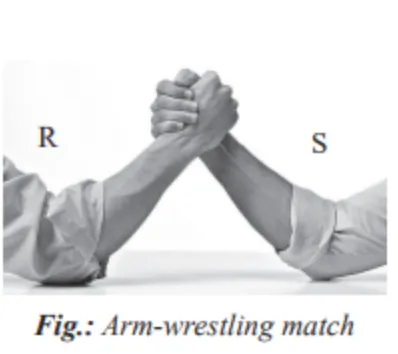
Ans. No. Since the arms are tilting (moving) in a specific direction, the forces are unbalanced.
If the arms tilt to the front direction (out of the page), then Player S is exerting the larger force. Movement always occurs in the direction of the larger force.
What If?
Q1. An object is moving with a constant velocity. Is there a net force acting upon it?
Ans. No. According to Newton’s First Law of Motion, if an object moves with a constant velocity (meaning no change in its speed or direction), the net force acting on it is zero.
Pause and Ponder
Q1. A toy car of mass 100 g is moving with a constant velocity of 0.5 m s⁻¹. What is the net force acting on the toy car?
Ans. Constant velocity means acceleration is zero: a = 0
Using Newton's second law: F = ma = m × 0 = 0
The net force acting on the toy car is zero.
NCERT Exercise Questions
Question 1
Q. Using a horizontal force F, a table is moved across the floor at a constant velocity. How much is the frictional force exerted by the floor on the table?
Ans. Since the table is moving at a constant velocity, the net force acting on it must be zero according to Newton’s First Law of Motion. This means the applied force F is perfectly balanced by the force of friction acting in the opposite direction.
Friction force exerted by the floor = F
Question 2
Q. While practising for the snake boat race (Vallum kalli in Kerala), 100 oarsmen are rowing a boat together. Out of these, 95 row backwards to propel the boat forward. But by mistake, 5 oarsmen row in the opposite direction. If each oarsman applies a horizontal force of 200 N, what is the net force on the snake boat? (Ignore drag forces, air friction, etc.)
Ans. There are 95 oarsmen who row backwards to propel the boat forward.
Total forward force = 95 × 200 N = 19,000 N
5 oarsmen row in the opposite direction (forward), which pushes the boat backward.
Total backward force = 5 × 200 N = 1,000 N.
Since these forces are in opposite directions. Solving for the net forward force;
Net forward force = 19,000 N − 1,000 N = 18,000 N
The net force on the snake boat is 18,000 N in the forward direction.
Question 3
Q. A sailor jumps out from a small boat to the shore. As the sailor jumps forward, will the boat move? If yes, in which direction and why.
Ans. Yes, the boat will move. The boat will move in the backward direction (away from the shore).
According to Newton’s third law of motion, when the sailor jumps forward, they push the boat backward with their feet (Action). Simultaneously, the boat exerts an equal force on the sailor in the forward direction (Reaction), enabling them to jump to the shore.
Question 7
Q. A sailor jumps out from a small boat to the shore. As the sailor jumps forward, will the boat move? If yes, in which direction and why.
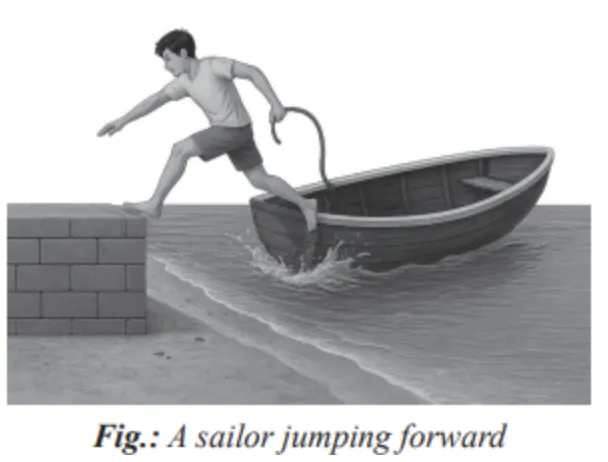
Ans. Yes, the boat will move. The boat will move in the backward direction (away from the shore).
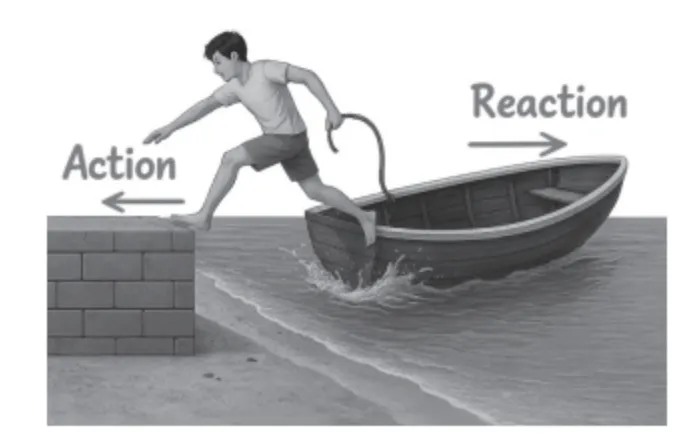
According to Newton’s third law of motion, when the sailor jumps forward, they push the boat backward with their feet (Action). Simultaneously, the boat exerts an equal force on the sailor in the forward direction (Reaction), enabling them to jump to the shore.
Question 8
Q. During a high jump event, a landing mat or sand bed is placed for the athlete to fall upon. Explain the reason behind it.
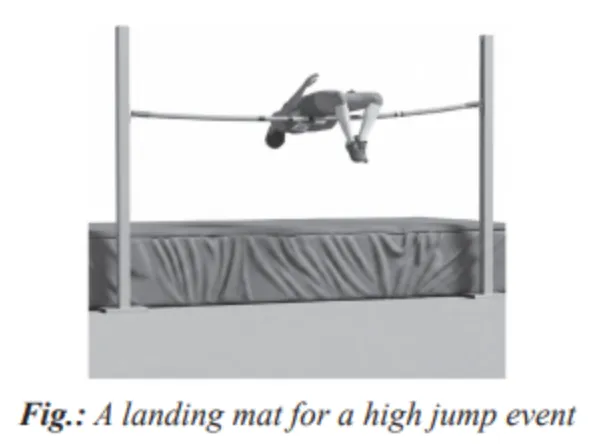
Ans. According to Newton’s Second Law of Motion, the force exerted on an object is proportional to the rate of change of momentum. When an athlete falls on a hard surface, their velocity reduces to zero almost instantly, resulting in a very high acceleration and a large, injurious force.
A soft landing mat or sand bed is compressible; as the athlete lands, the surface gives way, which increases the time taken for the athlete to come to rest, increasing the time reduces the magnitude of the acceleration and the resulting impact force, thereby preventing injury.
The Journey Beyond
Question 1
Q. You know that the force of friction depends on the nature of the surfaces in contact. Does it also depend on how hard the surfaces press each other? Is the friction acting on an object that is about to move larger than the friction after motion begins? Is the friction which acts on a rolling object less than that on a sliding object? Find answers to these questions and create an infographic. Such observations help explain why the invention of the wheel was a major milestone in human history.
Ans. Yes, the force of friction depends on how hard the surfaces press each other because frictional force increases with the normal force (weight). If pressing force increases the contact between the surfaces, making it more difficult for one surface to move over the other.
Yes, the friction acting on an object that is about to move is greater than the friction after motion begins because static friction is greater than sliding (kinetic) friction.
Yes, the friction acts on the rolling object less than the sliding object.
Infographics:
(i) Friction increases when surfaces press harder.
(ii) Friction before motion is greater than friction after motion begins.
(iii) Rolling friction is less than sliding friction.
Explore Class 9 Resources on PW for NCERT Solutions, chapter-wise notes, syllabus, and other essential study materials to make your learning easier.
Question 2
Q. Take two toy cars of equal mass and stick a bar magnet on top of each. Fix a metre scale on a smooth surface. Place the cars near the midpoint of the metre scale with the like poles touching. Release the cars and record the time taken (using two stopwatches), and distance travelled by each before coming to a rest. Repeat the experiment after adding equal masses to both cars. Did the cars travel equal distances in opposite directions? Plot a graph of distance travelled versus mass. Analyse and discuss your findings.
Ans.
Aim: To find whether two toy cars with like poles of magnets touching travel equal distances in opposite directions and how distance depends on mass.
Apparatus: Two toy cars of equal mass, two bar magnets, metre scale, smooth surface, weights (equal masses), two stopwatches.
Procedure:
Stick a bar magnet on the top of each toy car. Keep the like poles facing each other.
Fix a metre scale on a smooth surface. Place the cars near the midpoint (50 cm mark) with the like poles touching.
Release the cars simultaneously and start the two stopwatches.
Note the time taken by each car to stop and the distance travelled by each car from the midpoint.
Add equal masses (e.g., 50 g, 100 g, 150 g) to both cars and repeat the experiment.
Observations: (Example readings)
|
Total mass on each car (g) |
Time (s) – Left car |
Time (s) – Right car |
Distance (cm) – Left |
Distance (cm) – Right |
Average distance (cm) |
|
50 (only car) |
1.35 |
1.32 |
62 |
61 |
61.5 |
|
100 |
1.05 |
1.08 |
41 |
40 |
40.5 |
|
150 |
0.83 |
0.80 |
28 |
27 |
27.5 |
|
200 |
0.68 |
0.70 |
20 |
19 |
19.5 |
Result: Yes, the two toy cars travel equal distances in opposite directions when released. The like poles of the magnets repel each other and exert equal and opposite forces on the two cars. Since the cars have equal masses, they move away from each other in opposite directions and travel nearly the same distance.
When equal masses are added to both cars, the repulsive force between the magnets remains almost the same, but the increased mass makes the cars harder to move. Therefore, the cars travel a shorter distance before coming to rest. However, because equal masses are added to both cars, they still travel equal distances in opposite directions.
Graph of distance travelled versus mass
The graph shows that as the mass of the cars increases, the distance travelled decreases.
Analysis:
-
Like poles repel with equal and opposite forces (Newton's third law).
-
Since the masses are equal, both cars get the same acceleration in opposite directions, so they travel equal distances.
-
As mass increases, acceleration (a = F/m) decreases, so distance travelled decreases.
-
Time taken also decreases with more mass.
The Quest Continues...
Q. In the real world, friction is always present whenever surfaces are in contact. Scientists have been trying to find ways to reduce friction between surfaces by using lubricants, coatings or texturing of surfaces, streamlining shapes of objects, and by using magnetic levitation.
Ans. In the real world, friction is always present whenever two surfaces are in contact. Although friction is useful in many situations, it can also cause wear and tear and waste energy. Therefore, scientists and engineers continuously look for ways to reduce friction.
NCERT Solutions for Class 9 Science Chapter 6 PDF
Practising the questions from Class 9 Science Chapter 6 helps you revise important concepts and test your understanding of force and motion. The PDF includes detailed solutions, diagrams and calculations to support your revision and question practice.
Class 9 Science Chapter 6
Study without using the internet
How to Prepare with NCERT Solutions for Class 9 Science Chapter 6 by PW?
You can use NCERT Solutions to revise the chapter and practise applying the laws of motion to different situations. Follow these steps during your preparation:
-
Revise the main concepts: Go through force, friction, inertia, acceleration, momentum and Newton’s three laws of motion.
-
Practise numerical questions: Solve problems based on force, mass, acceleration, velocity and momentum. Pay attention to units and calculations.
-
Understand everyday examples: Relate concepts such as friction and action-reaction forces to situations like walking, rowing a boat and jumping.
-
Practise textbook questions: Attempt activity-based, in-text, and exercise questions to check your understanding.
-
Review your answers: Use the NCERT Solutions PDF to check your responses and revisit concepts that need more revision.
Force and motion are important concepts in understanding how objects behave in different situations. Practising NCERT Solutions for Class 9 Science Chapter 6 can help you revise Newton’s laws, friction and related numerical problems. Use the selected questions regularly and refer to the PDF whenever you need detailed explanations or diagrams.
NCERT Solutions for Class 9 Science Chapter 6 FAQs
Which topics are covered in Class 9 Science Chapter 6?
Why should you practise NCERT questions for Class 9 Science Chapter 6?
Are numerical questions included in Class 9 Science Chapter 6?
Where can you find detailed explanations for Class 9 Science Chapter 6?

